
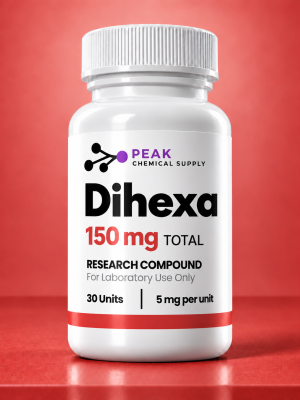
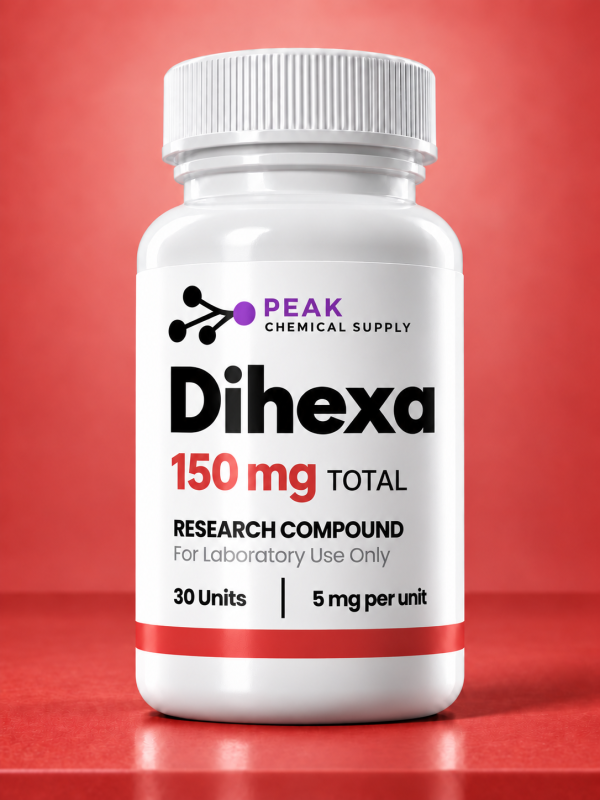
 Dihexa
$39.99 USD

6-[(2S,3S)-2-[(2S)-2-hexanamido-3-(4-hydroxyphenyl)propanamido]-3-methylpentanamido]hexanamide
CAS 1401708-83-5 · 30 × 5 mg · 150 mg total
30 × 5mg Dihexa. Research use only.

Research use only · Not for human or animal consumption
For In Vitro Research Use Only – Not for Human or Veterinary Application
Dihexa is a peptidomimetic cut down from angiotensin IV. Joseph Harding and John Wright's group at Washington State University took the Nle-Tyr-Ile core of Nle1-angiotensin IV and capped both ends: hexanoyl at the front, 6-aminohexanoic amide at the back. The goal was a version stable enough to survive metabolism. It was first characterized in 2012–2013.
Hexanoyl-Tyr-Ile-Ahx-NH2 · C27H44N4O5 · 504.7 g/mol · CAS 1401708-83-5 · PubChem CID 129010512
The developers proposed that Dihexa binds hepatocyte growth factor (HGF) and boosts HGF-driven activation of its receptor, c-Met, rather than acting at an angiotensin receptor. The main paper setting out that mechanism (Benoist et al., J Pharmacol Exp Ther 2014) was retracted in April 2025. A companion 2012 paper was also retracted, and the 2013 paper that first described Dihexa has carried an expression of concern since 2021. Later papers from other labs still call it an HGF/c-Met activator, but they rest on the original claim. Read the HGF/c-Met mechanism as a hypothesis.
There are no registered human trials.
Lot PCS-DX-1226F: 99.0% by LC-MS, PGL Chem, report dated February 12, 2026. 30 capsules of 5 mg per bottle.
Disclaimer
This compound has not been evaluated by the FDA. It is not intended to diagnose, treat, cure, or prevent any disease. All use must follow institutional and regulatory guidelines.
Terms of Sale
By purchasing, the buyer affirms they are a qualified researcher or institution. All sales are final. The purchaser assumes full responsibility for handling, use, and regulatory compliance. Dihexa reference material is supplied for qualified in vitro laboratory research only — not for human or veterinary consumption, administration, compounding, dispensing, diagnostic use, therapeutic use, or patient use.
Dihexa