
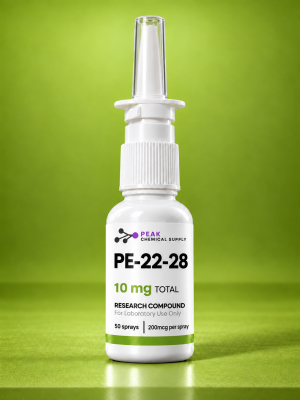
 PE-22-28 Spray
$29.99 USD


Gly-Val-Ser-Trp-Gly-Leu-Arg
CAS 1801959-12-5 · 6 ml
PE-22-28, 10 mg, liquid solution, 6 mL. Research use only.
 GB-115 Spray
$24.99 USD
Research use only · Not for human or animal consumption
For In Vitro Research Use Only – Not for Human or Veterinary Application
The starting point is sortilin, a sorting receptor also known as neurotensin receptor-3. Sortilin is made as a precursor, and when the enzyme furin cleaves it, a 44-amino-acid propeptide called "PE" is released. Residues 12–28 of PE form spadin, a 17-residue peptide that blocks the potassium channel TREK-1. Spadin breaks down in blood within hours. So a CNRS group at the Institut de Pharmacologie Moléculaire et Cellulaire (Valbonne, France) studied its degradation products and trimmed it down. In 2017 they reported PE 22-28, the last seven residues of spadin, as the shortest sequence that still blocked TREK-1.
Sequence Gly-Val-Ser-Trp-Gly-Leu-Arg (GVSWGLR) · Formula C35H55N11O9 · MW 773.9 g/mol · PubChem CID 165437303 · CAS (PubChem) 1801959-12-5
Unusually for this category, PE-22-28 has one well-defined target. In patch-clamp recordings of human TREK-1 expressed in HEK cells, it blocked the channel with an IC50 of 0.12 nM, against 40–60 nM for spadin. In mouse cortical neurons it raised levels of the synaptic marker PSD-95. A 2019 paper from the same group on "mini-spadin", likely the same peptide, reported a biphasic effect: TREK-1 activity rose at low concentrations and fell at higher ones. So "TREK-1 blocker" may be a simplification.
Essentially one primary paper names PE 22-28 directly (Djillani et al. 2017). It covers serum stability, electrophysiology, mouse behavioural models (forced swim, novelty-suppressed feeding, corticosterone) and hippocampal neurogenesis. Later mini-spadin papers from the same group used mouse stroke models and pancreatic beta cells. All of it comes from one lab, all animal work used injection, and no independent replication or human study exists. We found no nasal-delivery studies.
10 mg of PE-22-28 in 6 mL of sterile water, in a 15 mL white coated glass bottle with a spray top. No certificate of analysis is posted for PE-22-28 yet.
Disclaimer
This compound has not been evaluated by the FDA. It is not intended to diagnose, treat, cure, or prevent any disease. All use must follow institutional and regulatory guidelines.
Terms of Sale
By purchasing, the buyer affirms they are a qualified researcher or institution. All sales are final. The purchaser assumes full responsibility for handling, use, and regulatory compliance. PE-22-28 Spray reference material is supplied for qualified in vitro laboratory research only — not for human or veterinary consumption, administration, compounding, dispensing, diagnostic use, therapeutic use, or patient use.
PE-22-28 Spray