

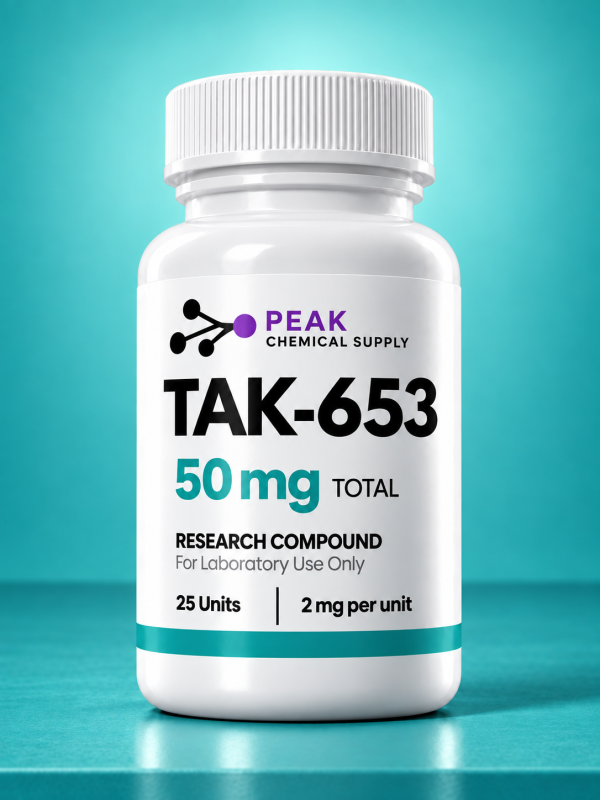
TAK-653For research use only. Not for human consumption.
9-(4-cyclohexyloxyphenyl)-7-methyl-3,4-dihydropyrazino[2,1-c][1,2,4]thiadiazine 2,2-dioxide
CAS 1358751-06-0 · 25 × 2 mg · 50 mg total
25 x 2mg TAK-653
Out of stock

Research use only · Not for human or animal consumption
Batch and analysis
- Batch
- PCS-TAK-2608A
- Assay method
- qNMR · third party
- Release spec
- ≥ 98%
- CAS
- 1358751-06-0
- Systematic name
- 9-(4-cyclohexyloxyphenyl)-7-methyl-3,4-dihydropyrazino[2,1-c][1,2,4]thiadiazine 2,2-dioxide
- Presentation
- 25 × 2 mg · 50 mg total
- Purity result
- 98.7% (qNMR · third party), lot PCS-TAK-2608A
- Also known as
- Osavampator, NBI-1065845
- Molecular formula
- C19H23N3O3S
- Molecular weight
- 373.5 g/mol
- PubChem CID
- 56655833
About this compound
For In Vitro Research Use Only – Not for Human or Veterinary Application
TAK-653 (osavampator): an AMPA potentiator built for low agonism
Earlier AMPA receptor potentiators had a problem: some of them also switched the receptor on directly. That agonist activity was linked to bell-shaped dose-response curves and seizure liability in animals. Takeda's Neuroscience Drug Discovery Unit in Fujisawa screened specifically for compounds that potentiate without that agonism. TAK-653 was the result, following a sister compound, TAK-137. Development later passed to Neurocrine Biosciences under the code NBI-1065845, and the compound now has the INN osavampator.
How it works
TAK-653 binds an allosteric site on the AMPA receptor's ligand-binding domain, and only when glutamate is bound. It strengthens the receptor's response to glutamate while having minimal agonist activity of its own. Crystal structures attribute the low agonism to interference at a single serine residue (Ser743 in GluA1 numbering). In cultured rat cortical neurons it increased phosphorylated mTOR, p70S6K, Akt and ERK, and raised BDNF protein.
Research so far
- In vitro: receptor binding, calcium influx in GluA1-expressing cells, patch-clamp, and brain-slice EPSPs.
- Rodent: rat working-memory and recognition-memory tasks, a submissive-behaviour depression model, convulsion safety-margin studies, and transcranial magnetic stimulation (TMS) of cortical excitability, proposed as a rat-to-human biomarker.
- Primate: a chronic-stress monkey study from an independent group at Sun Yat-sen University.
- Clinical: Phase 1 studies from 2015, a Phase 2 study, and a Phase 3 programme sponsored by Neurocrine that is recruiting as of November 2026. Not an approved drug.
Most of the primary pharmacology comes from Takeda and Neurocrine. Newer AMPA modulators are benchmarked against it.
Identity
9-(4-cyclohexyloxyphenyl)-7-methyl-3,4-dihydropyrazino[2,1-c][1,2,4]thiadiazine 2,2-dioxide · C19H23N3O3S · 373.5 g/mol · CAS 1358751-06-0 · PubChem CID 56655833
This lot
Lot PCS-TAK-2608A measured 98.7% by quantitative NMR at NuMega Resonance Labs, San Diego, report dated August 6, 2026. The certificate is linked under Batch and analysis. 25 capsules of 2 mg per bottle, 50 mg in total.
References
- 2021 paper, discovery and low-agonism mechanism: PMID 34267258
- mTOR/BDNF signalling and rat depression model: PMID 34655652
- TMS biomarker: PMID 34045439
- Monkey chronic-stress study (2025): PMID 40564108
- TAK-137, the sister compound: PMID 30209408
- PubChem: CID 56655833
Disclaimer
This compound has not been evaluated by the FDA. It is not intended to diagnose, treat, cure, or prevent any disease. All use must follow institutional and regulatory guidelines.
Terms of Sale
By purchasing, the buyer affirms they are a qualified researcher or institution. All sales are final. The purchaser assumes full responsibility for handling, use, and regulatory compliance. TAK-653 reference material is supplied for qualified in vitro laboratory research only — not for human or veterinary consumption, administration, compounding, dispensing, diagnostic use, therapeutic use, or patient use.
Questions
What else is TAK-653 called?
TAK-653’s international name is osavampator, and its development code is NBI-1065845. It’s registered under CAS 1358751-06-0 and listed in PubChem as CID 56655833.
What purity is this lot, and who tested it?
Lot PCS-TAK-2608A tested at 98.7% purity by qNMR, above our 98% release spec. The test was run by NuMega Resonance Labs, a third-party lab in San Diego, which is named on the certificate.
Where is the certificate for this lot?
The certificate for lot PCS-TAK-2608A is linked under Batch and analysis on this page. It’s also listed with all our other lots on the Certificates page.
How is it supplied?
Each pack holds 25 units of 2 mg, 50 mg of TAK-653 in total.
How should it be stored?
Keep it tightly sealed in a cool, dry place, protected from light and moisture. That’s the storage instruction printed on the label.