
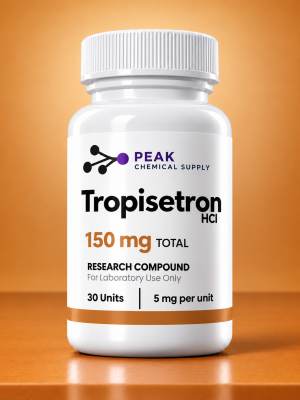
 Tropisetron
$35.99 USD


3-tropanyl-indole-3-carboxylate
CAS 105826-92-4 · 30 × 5 mg · 150 mg total
30 × 5mg Tropisetron. Research use only.
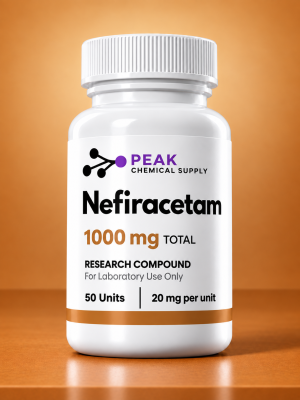 Nefiracetam
$29.99 USD
Research use only · Not for human or animal consumption
For In Vitro Research Use Only – Not for Human or Veterinary Application
Tropisetron (ICS 205-930) was one of the compounds in the 1985 Nature paper that described "a new class of drugs that selectively block serotonin M-receptors", the receptor now called 5-HT3. It went on to clinical use as an antiemetic under the name Navoban.
What makes it interesting as a research tool is a second action that its relatives lack. Tropisetron is also a potent, selective partial agonist at the α7 nicotinic acetylcholine receptor. Ondansetron doesn't have high α7 affinity.
Structure: the endo-tropanyl ester of indole-3-carboxylic acid. The free base is C17H20N2O2, 284.35 g/mol, CAS 89565-68-4, PubChem CID 656665. Our lot is the hydrochloride salt, as named on its certificate.
Which action drives a given result varies by model and isn't settled.
The literature runs to about 1,400 PubMed records from many independent groups. Outside antiemesis, the main lines are α7-linked inflammation, T-cell signalling, and Alzheimer's-model work. In that work it raised the sAPPα/Aβ ratio in J20 mice and reduced plaque and neuroinflammation markers in APP/PS1 mice. Early 1985 pharmacology also covered cardiac electrophysiology and gastric motility.
Lot PCS-TROP-2608A: 99.2% by quantitative NMR, NuMega Resonance Labs, report dated August 25, 2026. The certificate is linked above. 30 capsules of 5 mg per bottle.
Disclaimer
This compound has not been evaluated by the FDA. It is not intended to diagnose, treat, cure, or prevent any disease. All use must follow institutional and regulatory guidelines.
Terms of Sale
By purchasing, the buyer affirms they are a qualified researcher or institution. All sales are final. The purchaser assumes full responsibility for handling, use, and regulatory compliance. Tropisetron reference material is supplied for qualified in vitro laboratory research only — not for human or veterinary consumption, administration, compounding, dispensing, diagnostic use, therapeutic use, or patient use.
Tropisetron